

Dynamic Residential Proxies
Access 90M+ ethically sourced real residential IPs across 195+ countries and regions. Flexible rotation and sticky sessions provide reliable support for public data access.
- 99.9% Success Rate
- HTTP & SOCKS5
- <0.6s Response
 Sign Up with Google
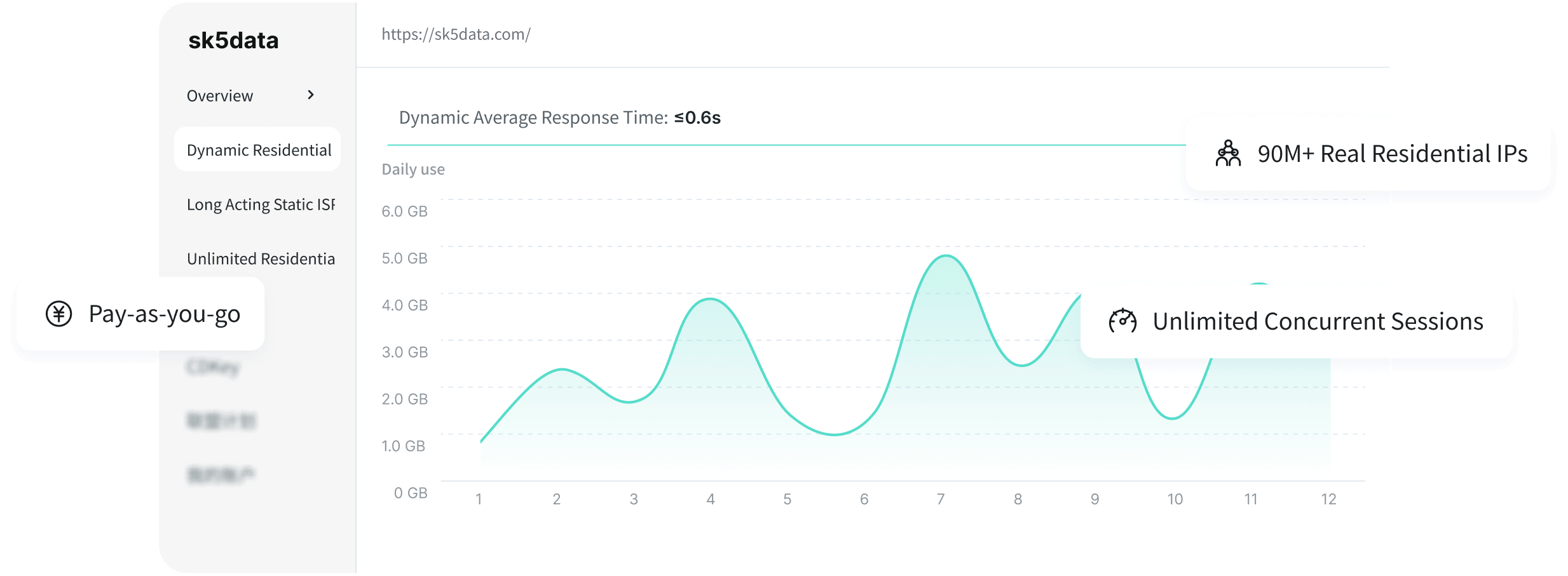
Building a More Flexible Residential Proxy Network for Data Access
Real residential networks and flexible IP management deliver stable, efficient data access.
Built on 90M+ real residential network resources to provide a more natural and reliable network environment for data access.
What Are Dynamic Residential Proxies?
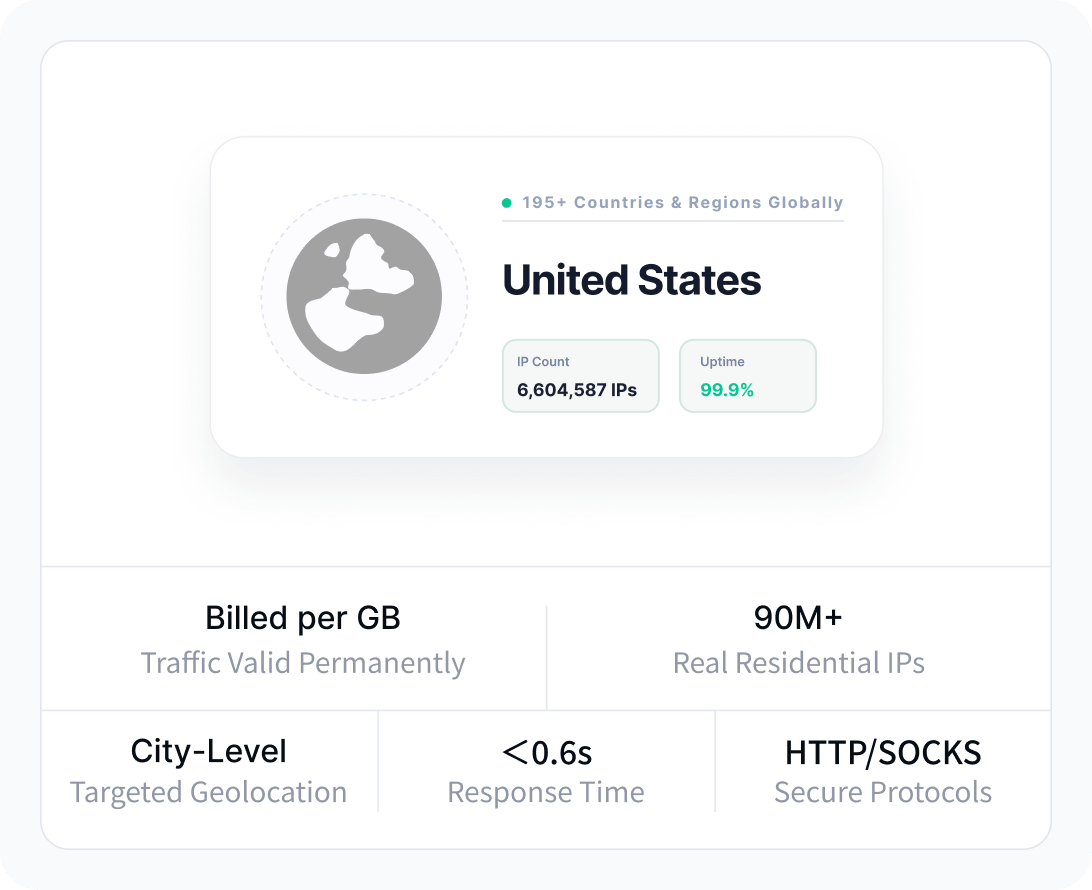
sk5data dynamic residential proxies assign IPs from real home networks, with flexible rotating and sticky sessions that match proxy resources to any data access need.
- 90M+ real residential IPs
- 195+ countries & regions
- City-level targeting
- HTTP / SOCKS5 protocols
Choose the Right Dynamic Residential Plan
Flexible configurations built to match different stages of data access needs.
- 90M+ Real Residential IPs
- Rotating & Sticky Sessions
- Billed By Traffic Usage
Popular Proxy Locations
Covering 195+ countries and regions, with proxy resources in major locations continuously updated to support global data access requirements.

United States
6,604,587 IPs

United Kingdom
2,473,581 IPs

Canada
1,278,069 IPs

Germany
1,903,353 IPs

France
1,952,740 IPs

Japan
4,931,080 IPs

Singapore
155,548 IPs

Australia
808,232 IPs
How Businesses Use sk5data Dynamic Residential Proxies?
Flexible solutions for different business needs, providing reliable and efficient proxy network support.

AI Data Collection
Collect public web data from different regions and in multiple languages to train AI models and update knowledge bases.
- Web Data Collection
- Data Access
- Multi-Regional Collection

SEO Monitoring
Monitor search engine ranking changes across different regions and track localized SERP data and keyword performance.
- SERP Collection
- Rank Tracking
- Keyword Analysis

Ad Verification
Verify ad creatives and landing pages from different regions, checking consistency and accuracy of ad delivery.
- Ad Verification
- Regional Testing
- Content Review

Market Research
Access regional market information and public data to analyze user needs, market trends, and competitor activity.
- Market Analysis
- User Analysis
- Trend Research

E-commerce
Monitor regional product prices, inventory, and market shifts to support e-commerce operations and competitor analysis.
- Price Monitoring
- Inventory Tracking
- Competitive Analysis

Travel Aggregation
Access regional travel product and service information, consolidating pricing, inventory, and localized content data.
- Price Collection
- Travel Data
- Localized Information
Flexible Access, Easy to Scale
Simple and intuitive proxy access, designed to fit different business environments and usage needs.
Select a traffic plan based on your business scale and specify the target country or city to match your required coverage.
#include "stdafx.h"
#include "curl/curl.h"
#pragma comment(lib, "libcurl.lib")
static size_t write_buff_data(char *buffer, size_t size, size_t nitems, void *outstream)
{
    memcpy(outstream, buffer, nitems * size);
    return nitems * size;
}

int GetUrlHTTP(char *url, char *buff)
{
    CURL *curl;
    CURLcode res;
    curl = curl_easy_init();
    if (curl)
    {
        // user:pass http
        curl_easy_setopt(curl, CURLOPT_PROXY, "http://user:pass@us.sk5data.com:5151");
        curl_easy_setopt(curl, CURLOPT_WRITEDATA, (void *)buff);
        curl_easy_setopt(curl, CURLOPT_WRITEFUNCTION, write_buff_data);
        curl_easy_setopt(curl, CURLOPT_URL, url);
        curl_easy_setopt(curl, CURLOPT_LOW_SPEED_TIME, 10L);
        curl_easy_setopt(curl, CURLOPT_LOW_SPEED_LIMIT, 50L);
        curl_easy_setopt(curl, CURLOPT_MAX_RECV_SPEED_LARGE, 2000000L);

        res = curl_easy_perform(curl);
        curl_easy_cleanup(curl);
        if (res == CURLE_OK)
        {
            return res;
        }
        else
        {
            printf("%d", res);
        }
    }
    return res;
}

int GetUrlSocks5(char *url, char *buff)
{
    CURL *curl;
    CURLcode res;
    curl = curl_easy_init();
    if (curl)
    {
        // user:pass socks5
        curl_easy_setopt(curl, CURLOPT_PROXY, "socks5://user:pass@us.sk5data.com:5151");
        curl_easy_setopt(curl, CURLOPT_WRITEDATA, (void *)buff);
        curl_easy_setopt(curl, CURLOPT_WRITEFUNCTION, write_buff_data);
        curl_easy_setopt(curl, CURLOPT_URL, url);
        curl_easy_setopt(curl, CURLOPT_LOW_SPEED_TIME, 10L);
        curl_easy_setopt(curl, CURLOPT_LOW_SPEED_LIMIT, 50L);
        curl_easy_setopt(curl, CURLOPT_MAX_RECV_SPEED_LARGE, 2000000L);
        res = curl_easy_perform(curl);
        curl_easy_cleanup(curl);
        if (res == CURLE_OK)
        {
            return res;
        }
        else
        {
            printf("%d", res);
        }
    }
    return res;
}

int main()
{
    char *buff = (char *)malloc(1024 * 1024);
    memset(buff, 0, 1024 * 1024);
    GetUrlHTTP("http://ipinfo.io/json", buff);
    printf("response: %s", buff);
    memset(buff, 0, 1024 * 1024);
    GetUrlSocks5("http://ipinfo.io/json", buff);
    printf("response: %s", buff);
    free(buff);
    Sleep(10 * 1000);
    return 0;
}Frequently Asked Questions
sk5data Dynamic Residential Proxies support HTTP and SOCKS5 protocols, ensuring compatibility with different tools, applications, and business systems.